
Speak Your Body's Language With AO Peptides
Right now, as you read this, the cells in your body are sending thousands of messages to one another. Your stomach might be letting your brain know it's almost time to eat, the cells around a small cut on your finger are being told to start healing, and your brain is already preparing your body to wind down for sleep tonight. Many of these messages are carried by the same kind of molecule, called a peptide.
These tiny messengers are at work in nearly every part of your body. They help turn the food you eat into usable energy, keep your immune system ready to respond when something needs attention, take the edge off pain after a hard workout, and guide the repair of everything from a sore muscle to a scraped knee.
Your skin depends on them as well. As your body's largest organ, your skin is constantly rebuilding itself, shedding old cells, making new ones, and producing the collagen that keeps it firm and smooth. Peptides help direct that work by letting your skin cells know when it's time to make more collagen, when to calm down after irritation, and when to repair damage from the sun or everyday wear.
Most skincare products are designed to care for the outside of your skin. A good cleanser clears away dirt and oil, a moisturizer helps your skin hold on to water, and sunscreen shields it from UV rays, and all three deserve a place in your routine. Peptides offer something different, because instead of simply sitting on the surface, they carry the same kinds of messages your skin cells already use to communicate with each other, encouraging your skin to do more of what it naturally does to take care of itself.
That idea is the foundation of AO Peptides. To see why it's so promising, it helps to take a closer look at what a peptide actually is, how it works as a messenger, and why your body may need a little extra help hearing those messages as you get older.
What Is a Peptide, Really?
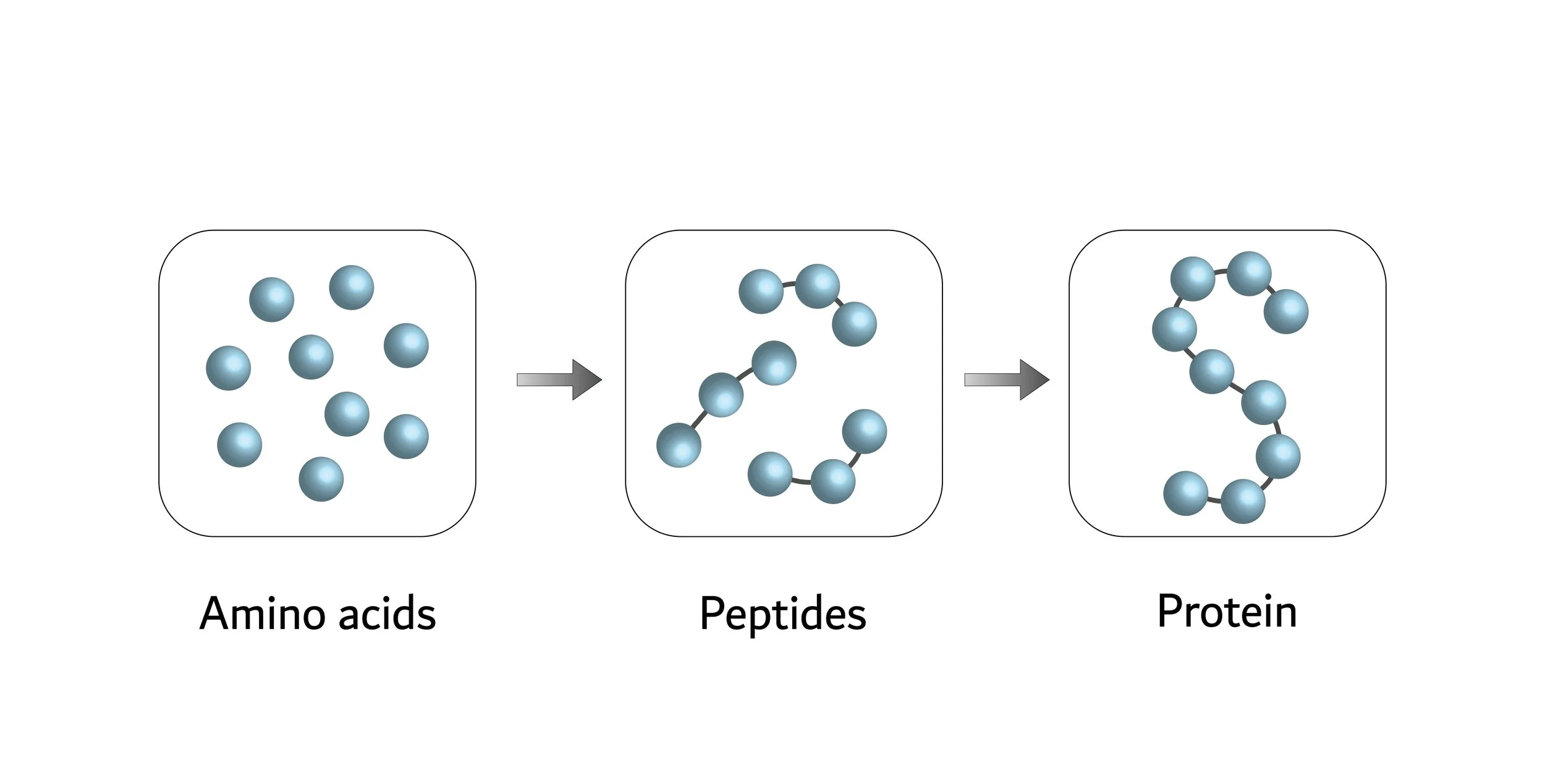
Every peptide starts with amino acids, the small building blocks your body uses to make just about everything it needs. There are about 20 different kinds, and your body links them together in chains, a little like stringing beads onto a necklace. When the chain is short, usually just a few amino acids up to around fifty, it's called a peptide, and when the chain grows into the hundreds or thousands, it becomes a protein.
That difference in size also tends to mean a difference in purpose. Many proteins serve as your body's building materials. Collagen, for example, is a long, sturdy protein that forms the framework holding your skin up, much like the beams inside the walls of a house. Peptides are more often the messengers, the ones that tell your cells what to build, what to repair, and when to slow down. If collagen is the frame of the house, peptides are the instructions that tell the construction crew where to work next.
Many of the peptides in AO Peptides are based on messengers your body already makes on its own, which means the signals in each vial are ones your body already recognizes and knows how to respond to.
How a peptide delivers its message
For a message to be received, it has to reach the right place. The surface of every cell is covered in receptors, which you can picture as tiny locks, and each peptide has a unique shape that works like a key, fitting certain locks and passing by others. When the right peptide connects with the right receptor, the cell gets its instruction and gets to work. This is why each peptide has its own specialty, and why one might encourage your skin to build collagen while another helps it settle down after irritation.
Size plays an important role here, too. You may have noticed skincare products that list collagen as a key ingredient, and while they can leave skin feeling soft, collagen is far too large a molecule to soak into your skin, so it mostly stays on the surface as a moisturizer. Peptides are much smaller, which gives them a better chance of reaching the cells that actually do the work. Rather than trying to add collagen from the outside, a peptide like GHK-Cu sends the message that encourages your skin to make more of its own.
What changes as we age
When you're young, your body sends these messages strongly and steadily, which is part of why younger people tend to bounce back faster, whether they're recovering from a tough workout, a late night, or a scraped knee. As we get older, though, our bodies don't send many of those signals as strongly as they used to, and the everyday work they guide begins to slow down.
Your skin is one of the places where these changes are easiest to see. With fewer reminders to do its everyday work, it makes collagen more slowly, takes longer to renew itself, and can start to look tired, thinner, or less resilient. Topical peptides are a way to bring those reminders back, giving your skin more of the messages it has always known how to answer.
How AO Peptides Help Bring Those Messages Back
AO Peptides was built around a simple but powerful idea: if your body's messages become weaker with age, you can help bring them back. The collection includes ten serums, made up of eight individual peptides, the GLOW Blend, which combines three of those peptides into one formula, and NAD+. Each one was chosen for the specific message it carries. Some focus on the skin, supporting firmness, calm, repair, and renewal. Others reach further, because many of the peptides in the collection play important roles throughout the body. NAD+, MOTS-c, Epithalon, and Thymosin Alpha-1, for example, are known for their connection to cellular energy, metabolism, immune balance, and healthy aging. Together, they let you support your skin and your overall wellness through one collection.
Why purity matters
Making a peptide is a precise process, with each amino acid added to the chain one at a time in a specific order, and the finished peptide only works if every one of them ends up in exactly the right place. Along the way, some chains come out too short or missing a piece, and the process can leave behind other material that has nothing to do with the peptide itself. Because those imperfect chains don't have the shape the peptide needs, they can't deliver its message to your cells the way a complete peptide can.
That's why peptides go through a purification process, and the grade of a peptide tells you how thoroughly it has been purified and tested. Peptides used in skincare are often made to cosmetic-grade standards, while pharmaceutical-grade peptides are held to the much stricter standards used in pharmaceutical manufacturing. Every peptide in AO Peptides is pharmaceutical grade, which means more of what's inside each vial is the exact peptide your body is meant to receive, so its message comes through as clearly as possible.
Why we chose topical
Many peptide therapies are given by injection, which can feel like more than many people want for their everyday wellness routine. We wanted AO Peptides to offer a gentler path, so we paired pharmaceutical-grade purity with the simplicity of topical application. Your skin is more than a protective layer. It's a living organ that is constantly taking in signals from its surroundings, and applying a peptide directly to it places that message right where you want to see results, whether that's your face, a patch of irritated skin, or your scalp.
It's a natural, non-invasive way to give your body the messages it already knows how to use, without needles or clinic visits, and it fits easily into a routine you can do at home in just a few seconds.
How your starter kit works
Peptides are delicate, and once they're dissolved in water, the water slowly begins to break the bonds that hold their amino acids together. Over time, that means a peptide stored in liquid gradually loses its strength. To protect each peptide at full potency, AO Peptides arrive as a dry powder sealed inside its own vial, where it stays stable until you're ready to use it.
When it's time to start a new serum, you activate it by adding bacteriostatic water, which keeps bacteria from growing after the vial has been opened. The powder dissolves in moments, and from there you attach the topical applicator and apply the serum one drop at a time.
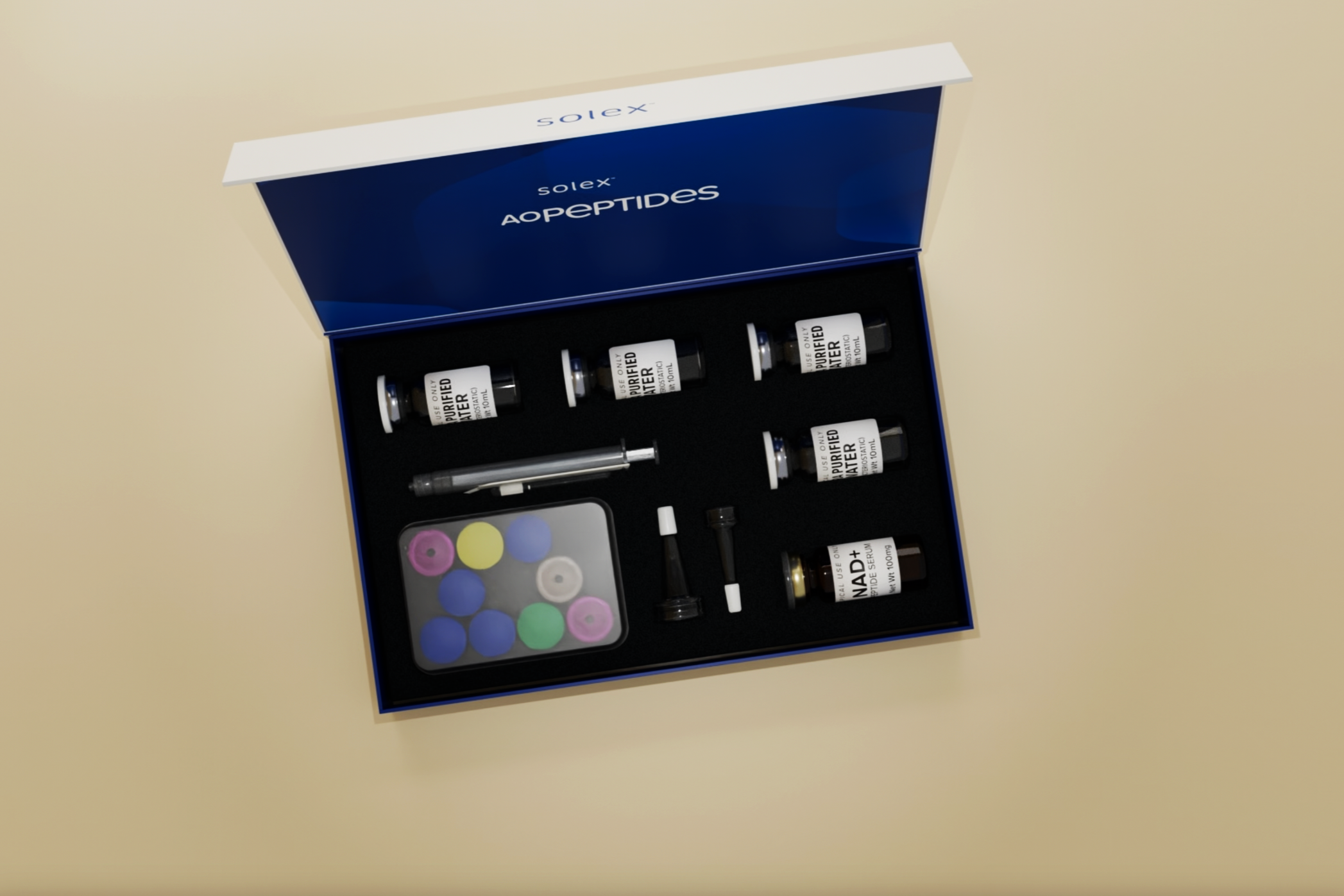
The starter kit includes everything you need to get going: all ten serums, four vials of bacteriostatic water for reconstitution, a syringe and needle tip, and two topical applicators, one for the smaller peptide vials and one for the larger NAD+ vial. The syringe and needle tip are used only to add water to each vial during activation. AO Peptides are made for topical use only and should never be injected.
Because everyone's body is different, the kit is designed to help you discover what works best for you. One serum might quickly become part of your everyday routine, while another becomes the one you reach for when you need a little extra support. The best place to start is getting to know each one and what makes it unique.
Getting to Know Each AO Peptide
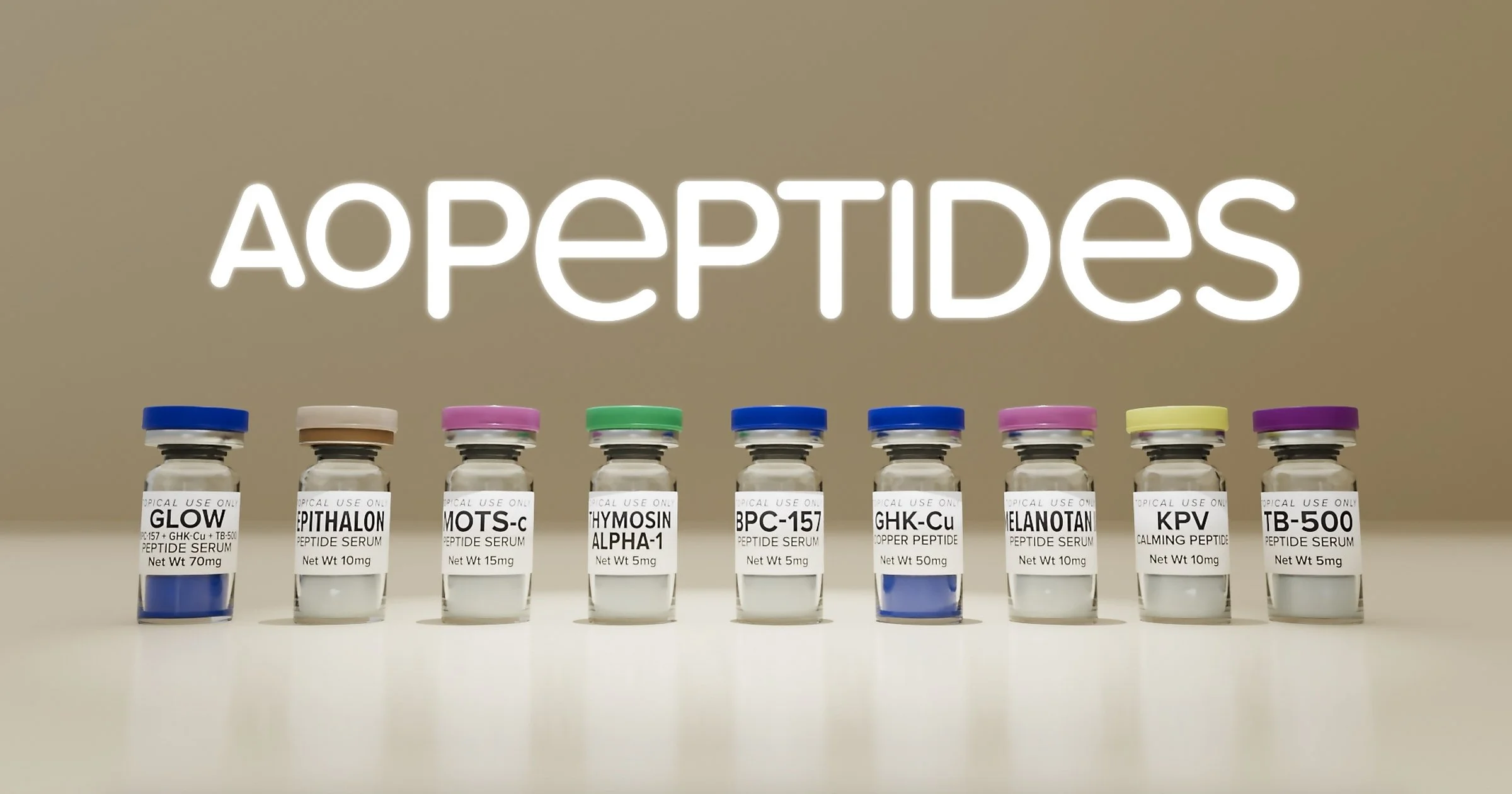
Each AO Peptides carries its own message, and understanding what each one does is the best way to decide where to begin. Some are focused on the look and feel of your skin, while others support processes that reach throughout your body.
-
GHK-Cu focuses on collagen, the protein that keeps your skin firm. As collagen production slows with age, skin can start to look thinner and less resilient, and GHK-Cu encourages your skin to make more of its own. It promotes collagen and elastin production for firmer skin with better tone and texture, supports your skin's natural renewal and repair, and helps manage oxidative stress.* On the scalp, it works at the level of the hair follicle to encourage fullness and support overall scalp health.*
-
KPV focuses on redness and irritation in the skin, which can come from too much sun, a reaction to a new product, or clothing that rubs against your skin throughout the day. It helps your skin feel calm and comfortable, supports its barrier function, and soothes skin that feels stressed.* KPV also aids the gut lining and digestive comfort.*
-
BPC-157 focuses on recovery, supporting the repair processes your body already relies on. On the skin, it helps you bounce back from breakouts, irritation, and everyday wear and tear.* It also aids gut lining and digestive wellness, supports joint and muscle recovery after activity, and supports healthy circulation.*
-
TB-500 focuses on renewal, supporting your skin's natural process of clearing away old tissue so smoother, fresher texture can form in its place.* It also supports muscle recovery after exercise, helps maintain flexibility and mobility, and promotes the body's natural repair processes.*
-
GLOW Blend combines GHK-Cu, BPC-157, and TB-500 into one formula, bringing collagen support, repair, and renewal together in a single serum. It promotes collagen production and skin firmness, helps maintain tone, texture, and elasticity, and aids skin repair.* It also encourages healthy skin aging and supports hair and scalp health.*
-
NAD+ is found in every cell of your body, where it helps your cells function the way they were designed to. When skin cells are low on energy, skin can look dull and tired, and NAD+ supports the energy those cells need.* It also supports mitochondrial function and your cells' natural maintenance processes, helps maintain a healthy metabolism, aids mental clarity and energy, and supports healthy cellular aging.*
-
Epithalon focuses on longevity, supporting your skin and body over the long term. It supports cellular longevity and renewal, aids telomere maintenance, promotes sleep quality and a balanced circadian rhythm, and supports healthy aging.* Epithalon also pairs well with NAD+, since NAD+ supports how well your cells perform while Epithalon supports how long they can keep performing at their best.
-
Thymosin Alpha-1 focuses on immune balance. Your skin has its own immune function, and when that function is balanced, you tend to see fewer reactive days, more resilience, and a barrier that does its job of protecting you.* Thymosin Alpha-1 also supports your body's overall immune resilience and natural defenses, helping you stay strong through busy or stressful seasons.*
-
MOTS-c focuses on how well your skin and body hold up under everyday stress, such as weather changes, your environment, or a long, demanding week. It supports cellular resilience and helps maintain metabolic balance.* MOTS-c also encourages exercise capacity and stamina, aids cellular energy and mitochondrial function, and supports healthy aging.*
-
Melanotan II supports skin and hair pigmentation and melanin production, helping your skin's pigment respond more readily for a naturally tanned look.* Because your skin responds more quickly, Melanotan II means you need less time in the sun, not more. It provides no sun protection, so wear a broad-spectrum sunscreen whenever you're outdoors, avoid spending too much time in the sun, and don't use tanning beds while using it.
Building Your Routine
With ten serums to choose from, the easiest way to begin is with one or two that match what you'd most like to support. Starting small gives you the chance to see how your skin responds to each serum before you add another, and over time, you'll build a routine around the ones you enjoy most rather than one that follows someone else's.
Apply your serums to clean skin, where nothing stands between the peptide and the skin it's meant to reach. After cleansing, place a few drops on the area you'd like to focus on, give them a moment to absorb, and then continue with the rest of your routine, including your moisturizer and sunscreen.
Peptides work gradually, since the messages they carry support processes your skin carries out over weeks, not hours. Using your serums consistently, day after day, gives your skin the steady support it needs, and paying attention to how it looks and feels along the way will help you decide which serums earn a permanent place in your routine.
Using Your AO Peptides
-
Each AO Peptide arrives as a powder, and preparing it takes only a few minutes. All you're adding is water; once the powder dissolves, your serum is ready to use. Start with clean hands and a clean surface and work through the vials one at a time.
Before you begin, set out a few alcohol wipes, or cotton pads and 70% isopropyl alcohol; you'll use them to clean the needle between vials.
Prepare Each Vial
If the needle and syringe arrive separately, twist the needle onto the syringe until it's snug.
Take the cap off one peptide vial and one water vial. Under each cap is a rubber stopper; leave both stoppers in place (you will need them for the next step)
Push the needle through the water vial stopper and pull back the plunger to draw the water: 3 mL for a 3 mL peptide vial, or a full water vial (10 mL) for the 10 mL peptide vial.
Push the needle through the peptide vial stopper. The vial is vacuum-sealed and pulls the water in on its own; you won't need to press the plunger.
Swirl gently until the solution is clear. Do not shake the vial.
Before moving to the next peptide, wipe the needle with alcohol and let it dry for a few seconds.
When the last vial is done, place the needle and syringe in a sealed, rigid container before they go into the trash.
Fitting the Dropper Top
When you're ready to use a serum, pull the rubber stopper off the vial and press the dropper top into place. Your kit includes two: one stays with the 10 mL vial, and the other is shared by the nine 3 mL vials. When you switch serums, rinse the shared dropper top with warm water or wipe it with alcohol, and let it dry completely before it touches the next vial.Good to Know
A few small things make preparation even easier:When reading the syringe, hold it upright at eye level and read the mark that lines up with the top ring of the plunger stopper, the ring nearest the needle; the numbers are milliliters (mL). If an air bubble rises in the barrel, tap it to the top, ease it out, and finish drawing to your mark.
When a water vial is nearly empty, turn it upside down with the needle still inside, keeping the tip below the water line as you draw.
The vacuum seal works only once, so if you come back to add more water to a vial you've opened before, press the plunger to push the water in.
The suggested amounts give each serum its intended strength, but you can tailor them. Adding more water makes a gentler, more diluted serum; if the total is more than the vial holds, such as 6 mL into a 3 mL vial, transfer the contents to a larger clean container before adding the rest. Adding less water makes a more concentrated serum, so a drop or two goes further.
-
In powder form, AO Peptides keep for up to one year from their manufacture date. Refrigerate or freeze unopened vials to preserve them longest. Once prepared, refrigerate each serum and use it within 30 days.
Adjusting the amount of water changes how long a serum keeps, so plan to use a customized serum sooner.
Rinse the shared dropper top and allow it to dry fully between serums. Keep droppers away from skin, and do not share vials.
Discard any serum that becomes cloudy, changes color, or develops an unusual odor.
-
Your AO Peptides are only the beginning. Pair them with the rest of the AO family and get even more out of every drop.
AO Patch
The perfect companion to your peptides. Add two or three drops of any serum to the Patch's reservoir and wear it wherever you like; your serum will stay in a concentrated area and will be boosted with negative ions.
AO Brite
Mix a few drops of your peptide serum into Brite in your palm, layer them one after the other, or add your serum straight into the Brite bottle. Brite's hyaluronic acid draws in moisture, and well-hydrated skin makes the most of every serum.
AO Mask and AO Infinity Wand.
Finish skin-focused days with a red light session, following each device's own guide.
-
IMPORTANT: FOR TOPICAL USE ONLY. DO NOT INJECT.
AO Peptides are for external use on the skin. Injection of this product can cause serious harm. The included syringe and needle are for reconstitution purposes only, turning the peptides into serums. Do not use the syringe or needle on the skin or body. Keep all vials, the syringe, and the needle out of reach of children.
Avoid contact with eyes; if contact occurs, rinse thoroughly with water.Patch test before first use. Discontinue use if irritation occurs.
Keep out of reach of children.
If pregnant, nursing, or under a doctor's care for a skin condition, consult your healthcare provider before using.
Melanotan II is not intended for individuals under 18 and provides no sun protection. Avoid overexposure to the sun and tanning beds while using it, and always wear broad-spectrum sunscreen outdoors; excess UV exposure damages skin and increases the risk of skin cancer.
AO Peptides are cosmetics intended to enhance the appearance of skin. They are not intended to diagnose, treat, cure, or prevent any disease.
Supporting Your Body, One Message at a Time
Peptides are one of the newest and most exciting areas of health and wellness, and for many people, they're still unfamiliar. As more people discover them, more questions come up about how peptides are made, how they should be used, and how to know you're choosing a good one. The answer comes down to doing them right, and that's what AO Peptides was built to do.
You don't need a science background to get started. With pharmaceutical-grade purity, serums activated fresh, and a gentle routine you can follow at home, AO Peptides takes care of the details so you can focus on finding the serums that work best for you.
Your body has been sending these messages since the day you were born, and it still knows exactly how to answer them. AO Peptides gives you a pure, fresh, and gentle way to send it more of what it needs, right from your own home.
*These statements have not been evaluated by the Food and Drug Administration. This product is not intended to diagnose, treat, cure, or prevent any disease.