
Your Brain Is Responding to Your Gut More Than You Think

For years, most of us were taught to think about the brain and the gut as two separate systems. The brain handled thoughts and emotions. The gut handled digestion. If something felt mental, we focused on the head. If something felt physical, we focused on the stomach.
Over the last several years, research has begun telling a more integrated story, one that feels both practical and empowering.
In a recent podcast conversation that caught our attention, Professor Tim Spector, a medical doctor and Professor of Genetic Epidemiology at King’s College London, reflected on how his understanding of the brain has evolved. Earlier in his career, he viewed the brain as somewhat isolated from the rest of the body. It was complex and important, but largely operating in its own domain. What shifted his thinking were the results of nutritional studies aimed at improving gut health.
Participants were given dietary interventions to support their microbiome. Researchers expected digestive improvements to appear first. Instead, many participants reported improvements in mood, energy, and hunger regulation before major laboratory markers changed.
That pattern appeared consistently enough to raise a meaningful question. What if the brain is responding to the gut more directly than we once assumed?
Your Brain Is Listening to Your Gut More Than You Think

At the center of this conversation is the vagus nerve, a long nerve that connects the digestive system to the brain. It serves as one of the primary communication pathways between the two.
What makes this connection especially compelling is the direction of communication. Approximately 80 percent of signals travel from the gut to the brain, while only about 20 percent travel from the brain to the gut.
This means your brain is continuously receiving information from your digestive system. It interprets signals related to microbial balance, inflammation, nutrient availability, and metabolic activity. The brain is not detached from these processes. It is responsive to them.
For someone new to this topic, that realization can feel surprising. We often think of the brain as the command center that directs the body. In many ways, that is true. At the same time, the brain is listening. It adjusts to the internal environment created within the gut.
When the gut environment is balanced and well supported, the signals being sent upward tend to reflect that stability. When the gut is inflamed or imbalanced, signaling reflects that as well.
This perspective does not reduce complex emotional experiences to digestion alone. It simply acknowledges that the body is interconnected.
Why Plant Diversity May Be the Missing Piece in Gut Health
One of the most practical takeaways from the research discussed in the podcast was surprisingly straightforward. Increase plant diversity.
The recommendation was not about complicated protocols. It centered on variety. Different plants contain different types of fiber and phytonutrients. Those fibers feed different strains of beneficial microbes. A more diverse microbiome is generally associated with greater resilience and balance.
In clinical comparisons, multi plant prebiotic blends influenced significantly more beneficial microbial strains than traditional probiotics alone. Participants reported improvements not only in digestive comfort but also in energy levels, fullness, and overall satisfaction after meals. Some noted improvements in mood as well.
Researchers did not initially set out to study mood changes. Those outcomes appeared as consistent secondary observations, reinforcing the broader connection between gut ecology and systemic wellbeing.
For many people, this reframes gut support. It is no longer just about bloating or regularity. It becomes part of a larger conversation about how the body communicates internally.
Formulated for the Way the Body Actually Communicates
This integrated understanding of gut-brain communication is foundational to how AO Gut was formulated.
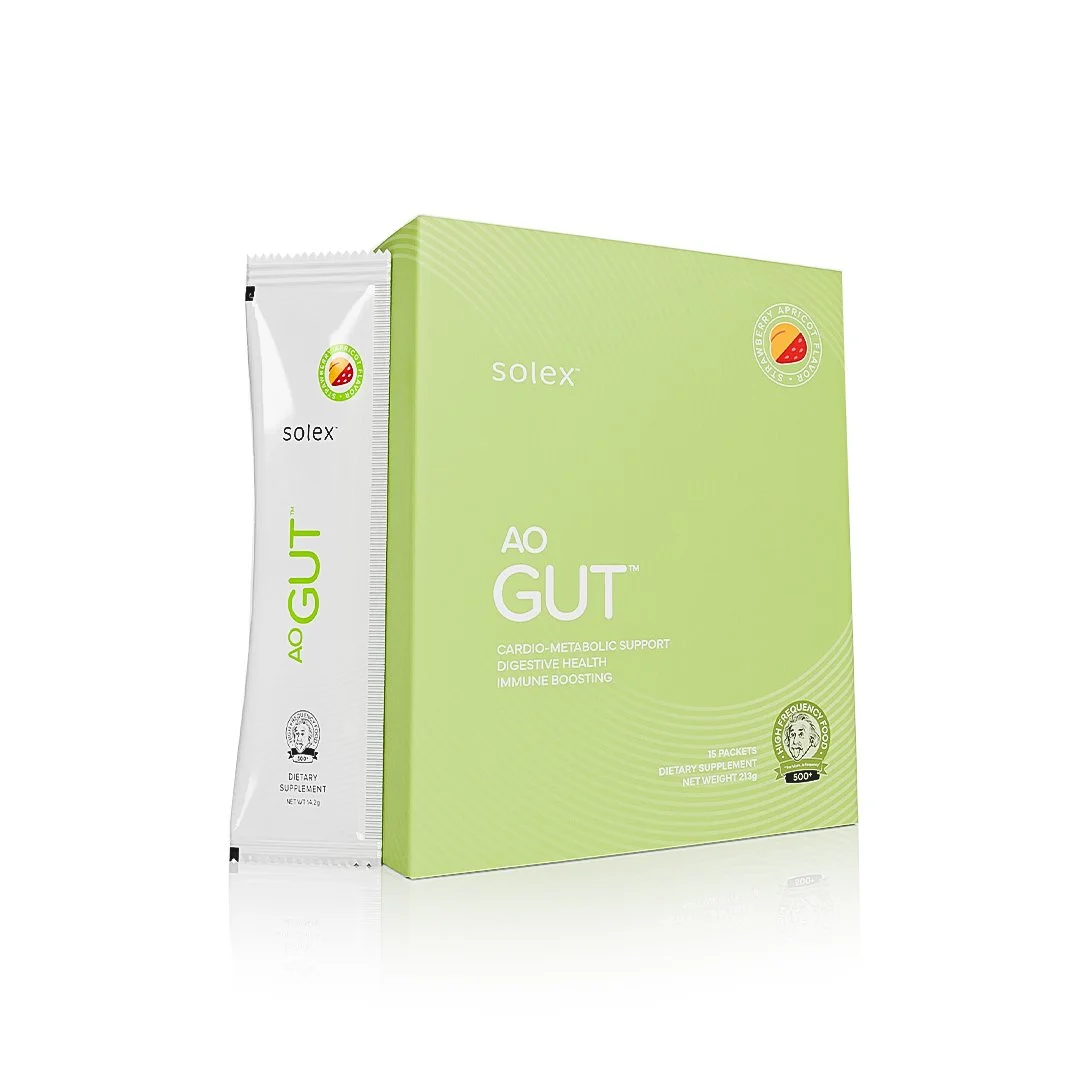
AO Gut was not designed as a single-ingredient solution or a quick digestive fix. It was developed with the recognition that the gut functions as an ecosystem, and ecosystems require nourishment, diversity, and balance.
Rather than relying solely on isolated probiotic strains, AO Gut focuses on feeding and supporting the environment those beneficial microbes depend on. That distinction matters. When you nourish the microbiome through diverse plant fibers and phytonutrients, you are supporting broader communication pathways throughout the body.
AO Gut incorporates 20 plant-based ingredients across three complementary blends designed to support digestive balance, microbial nourishment, and cardiometabolic health.
The Cardiometabolic Blend includes soluble fibers such as psyllium seed husk and beta glucan, along with phytosterols, konjac root, oat and apple fiber, rice bran, chicory root, and supportive gums. These ingredients help nourish beneficial microbes while supporting cholesterol balance and digestive regularity.
The Green Digestive Blend introduces nutrient-dense plants like spirulina, chlorella, broccoli, kale, and spinach. These ingredients provide phytonutrients and antioxidants that contribute to metabolic and cellular support.
The Immune Boosting Blend features botanicals including Camellia sinensis, grape seed, burdock root, peppermint leaf, ginger, aloe vera, and licorice root. Each was selected for its role in digestive comfort, inflammatory balance, and overall system support.
Together, these plants create a layered approach. They provide fiber diversity, targeted botanical support, and metabolic reinforcement in a way that reflects how the body actually communicates internally.
When the gut ecosystem is nourished consistently, the signals being sent to the brain and the rest of the body reflect that support. That is the philosophy behind AO Gut. It is not simply about digestion. It is about strengthening one of the body’s primary information networks.
Why Gut Health Is Bigger Than Digestion
For years, gut health was often reduced to comfort and regularity. That conversation is expanding. As research continues to evolve, it becomes clearer that the gut plays a central role in how the body communicates internally.

The brain does not operate in isolation. It is continuously interpreting signals from the microbiome, the nutrients we consume, and the inflammatory environment within the digestive tract. When we support that internal ecosystem with greater plant diversity and targeted nourishment, we influence one of the body’s primary communication pathways.
This is what makes the gut-brain connection so compelling. It is not about quick fixes or isolated outcomes. It is about supporting the system in a way that reflects how it was designed to function.
That philosophy is what informed the development of AO Gut. By focusing on plant diversity, fiber variety, and ecosystem support rather than a single-ingredient approach, it was created to align with the way the body naturally communicates and adapts.
Your brain is responding to your gut more than you think. When we begin to understand that connection, our approach to supporting it becomes more thoughtful and more intentional.
If this perspective feels new or worth exploring more deeply, we encourage you to watch the full podcast conversation with Professor Tim Spector that inspired this reflection. Hearing the research directly adds meaningful depth to this evolving conversation. Watch the full episode below.
When we begin to understand how the body communicates internally, our approach to supporting it becomes more thoughtful, more informed, and ultimately more effective.

Learn More About AO Gut.
In the U.S., one in three adults suffers from Cardiometabolic Syndrome, a public health concern that dramatically raise the risk of heart disease, heart failure, stroke and diabetes, as well as other non-cardiovascular conditions. Cardiometabolic Syndrome is a cluster of risk factors that, when they occur together, prevent the body from responding to insulin and hinder the body’s ability to process food into energy efficiently. These…
* This statement has not been evaluated by the Food and Drug Administration. This product is not intended to diagnose, treat, cure, or prevent any disease.